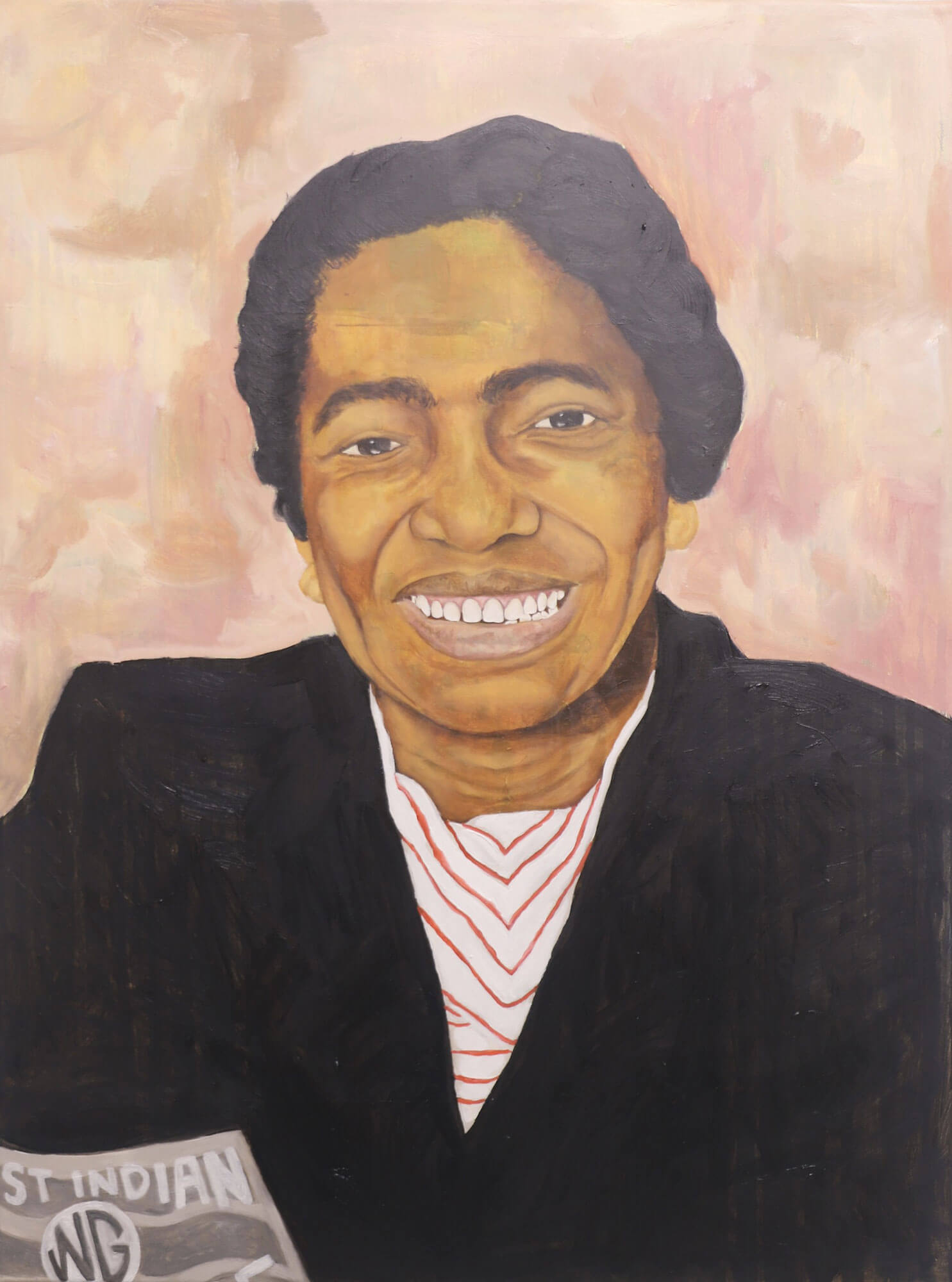
Claudia Jones
Biography
Claudia Vera Cumberbatch Jones was born in 1915 in Port of Spain, Trinidad. Raised in Harlem, New York from the age of nine, she was politicised by experiences of poverty, racism and the exploitation of Black workers. Her mother died an overworked and underpaid garment worker, and Jones herself contracted tuberculosis as a teenager – a disease fuelled by overcrowded living conditions. While working in retail and laundrettes, she began her lifelong commitment to journalism with a political column, “Claudia Comments”.
In 1936, she joined the American Communist Party (CPUSA), impressed by its defence of the Scottsboro Boys. Within a year, age 22, she was contributing to its publications and editing key titles like The Daily Worker, Spotlight and Weekly Review. She pushed the Party to expand its political thought to include the gendered struggles of Black women, and in 1949 published her landmark essay An End to the Neglect of the Problems of the Negro Woman!. In it she argued that poor Black women were subject to “super-exploitation” under capitalism – decades before “intersectionality” was coined.
Jones’ writing and political organising drew the attention of the U.S. government. Amid Cold War McCarthyism, she was repeatedly arrested, imprisoned, and eventually deported to Britain in 1955. There, she continued her activism, founding the West Indian Gazette in 1958. The Gazette became a major Black newspaper in Britain, championing anti-imperialist politics, Caribbean arts and literature, and international liberation movements in South America, Asia, Africa and the US.
In 1959, Jones helped launch the Caribbean Carnival in London in response to racist attacks and restrictive immigration laws. Her vision was for a proud display of West Indian joy, culture and resistance. The annual event laid the foundation for today’s Notting Hill Carnival.
Jones died from a tuberculosis-related heart attack on Christmas Eve 1964 at just 49. She is buried in Highgate Cemetery, to the left of Karl Marx – a fitting resting place for a woman with a tireless commitment to anti-imperialism, Pan-Africanism, Black women’s liberation and international Afro-Asian solidarity.